
George Masons club football team is laying the groundwork to be a successful football program. They only need the university to share that same vision.
By Brett Sprinkel
10:30 AM. George Mason University has a football game today, and it is just under three hours till kickoff. First-year Head Coach Arron Raffle arrives at the field and meets with members of the officiating crew to instruct them where to park, and where they can get changed. Shortly after that interaction, his players begin to trickle onto the field carrying important equipment needed to make sure that the field is ready to play on. As they transport pylons, yard markers, and the goal post padding, Raffle steps away to set up the PA system. The football field at the George Mason Recreational and Athletic Complex (RAC field) is not equipped with a traditional public announcement system. Instead, Raffle sets up his own PA system using his DJ equipment from his part-time job as a wedding DJ.
Raffle has been a wedding DJ for almost 30 years. He categorizes it as a fun side gig that allows him to travel to different places and meet new people. However, it does not get in the way of his true passion, football. Raffle has been around the game of football for just as long as he has been a DJ. In his career, he has played semi-pro football for the Virginia Monarchs, coached defense and special teams for the DC Divas, and most recently was the Head Coach and defensive coordinator for Thomas Jefferson High School in Alexandria, Virginia.
After he finishes setting up his DJ equipment in the stands, he strolls down to the field and converses with some of the players who are setting up the field equipment. Raffle’s relationship with the players is different from almost every other football coach in the country. It is different because Raffle is not employed by the school, he is employed by the players he coaches.
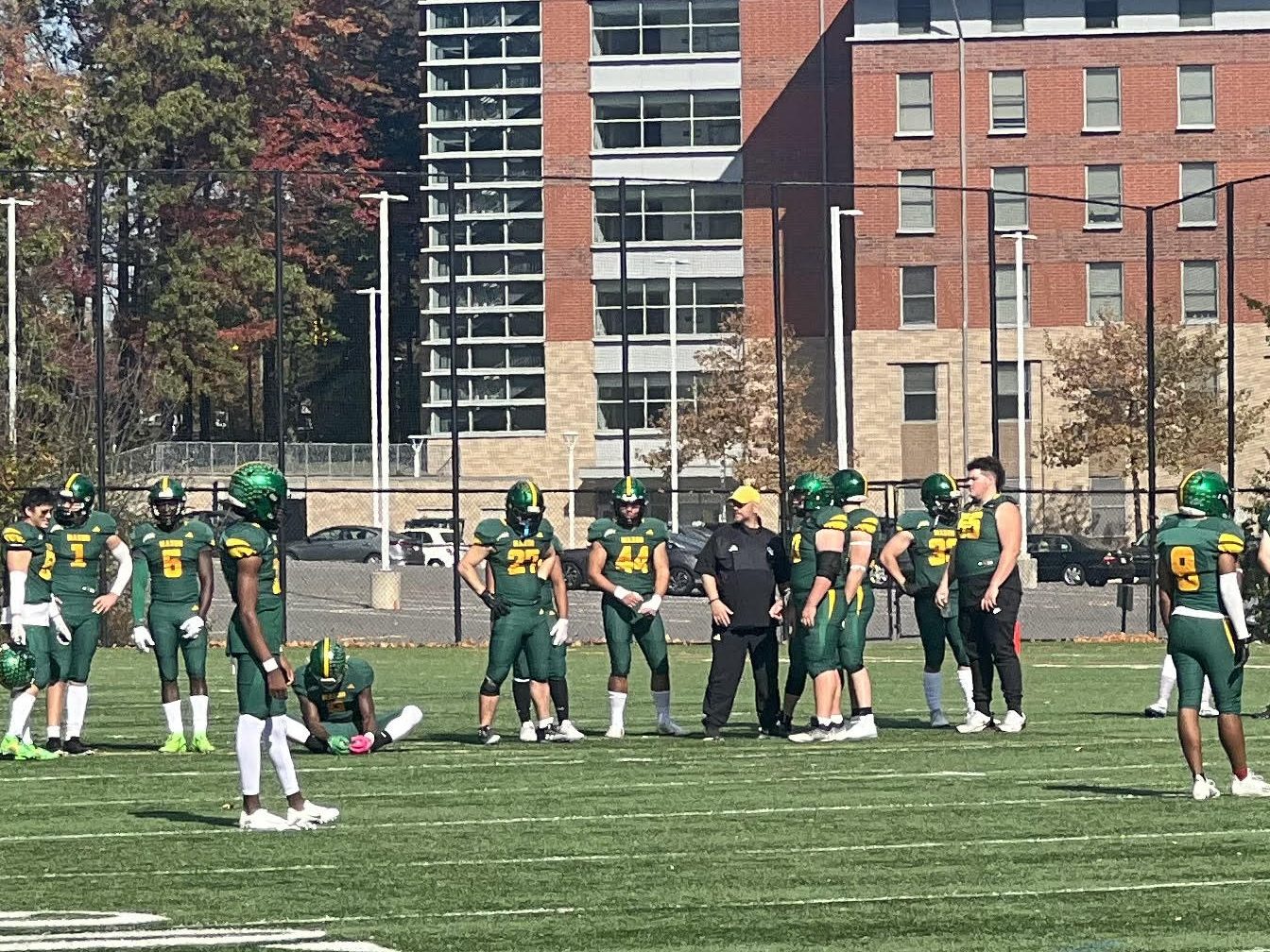
“An opportunity had popped up with Mason and [we] wanted to see where it would take us. And yeah, I took the majority of my staff with me…”
College club sports are student-run organizations with little to no help from their colleges with funding, and management. This club is led by President Cole Jasmin, Vice President Basil Hasan, and team Treasurer Seth Constable. These three are responsible for scheduling games, coordinating travel, and controlling where the team spends its money. This past offseason they led a search for a new head coach, one that saw them meet with several qualified candidates before they all came to an agreement that Arron Raffle was the right man for the job. “We interviewed a few different candidates, and there were some we really liked.” said club VP Hassan, “But as we got close to deciding, it was clear that Coach Raffle was the right person for the job”.
Club teams receive almost no funding from their school, forcing the team to rely on donations and player buy-ins to pay for travel, uniforms, and the coach’s salary. “Being the coach who is not part of the administration is a little different for me…” says Raffle, “So, we don’t control the budget. We don’t control any financial transactions, but we offer guidance to the club.”
It is rare to see a coach transition from being a high school head coach, to a club head coach. Most coaches would likely take a demotion to be a position coach on a Division I or Division II football team to boost their resume for future jobs. For Raffle, however, he sees this as an opportunity to build something at George Mason and he is not alone in seeing the potential of this job. “An opportunity had popped up with Mason and [we] wanted to see where it would take us. And yeah, I took the majority of my staff with me, unfortunately for TJ, but fortunate for Mason.”
“We’ve had several players from opposing teams that have spoken with us after games, and are transferring in the spring.”
Noon. Kickoff is scheduled for 60 minutes from now and the George Mason football team marches onto the field, to begin their stretching and warm-up routine. Their opponent has yet to arrive, and they have already phoned ahead to say that they are running late. As the players split up into their position groups, offensive and defensive line coach Enoch Boateng, who is one of the coaches that followed Raffle to George Mason, leads his players to the endzone and runs them through some drills. “Coach Raffle got me into coaching,” exclaims Boateng, “he typically surrounds himself with good people and we all share the same vision for this team.”
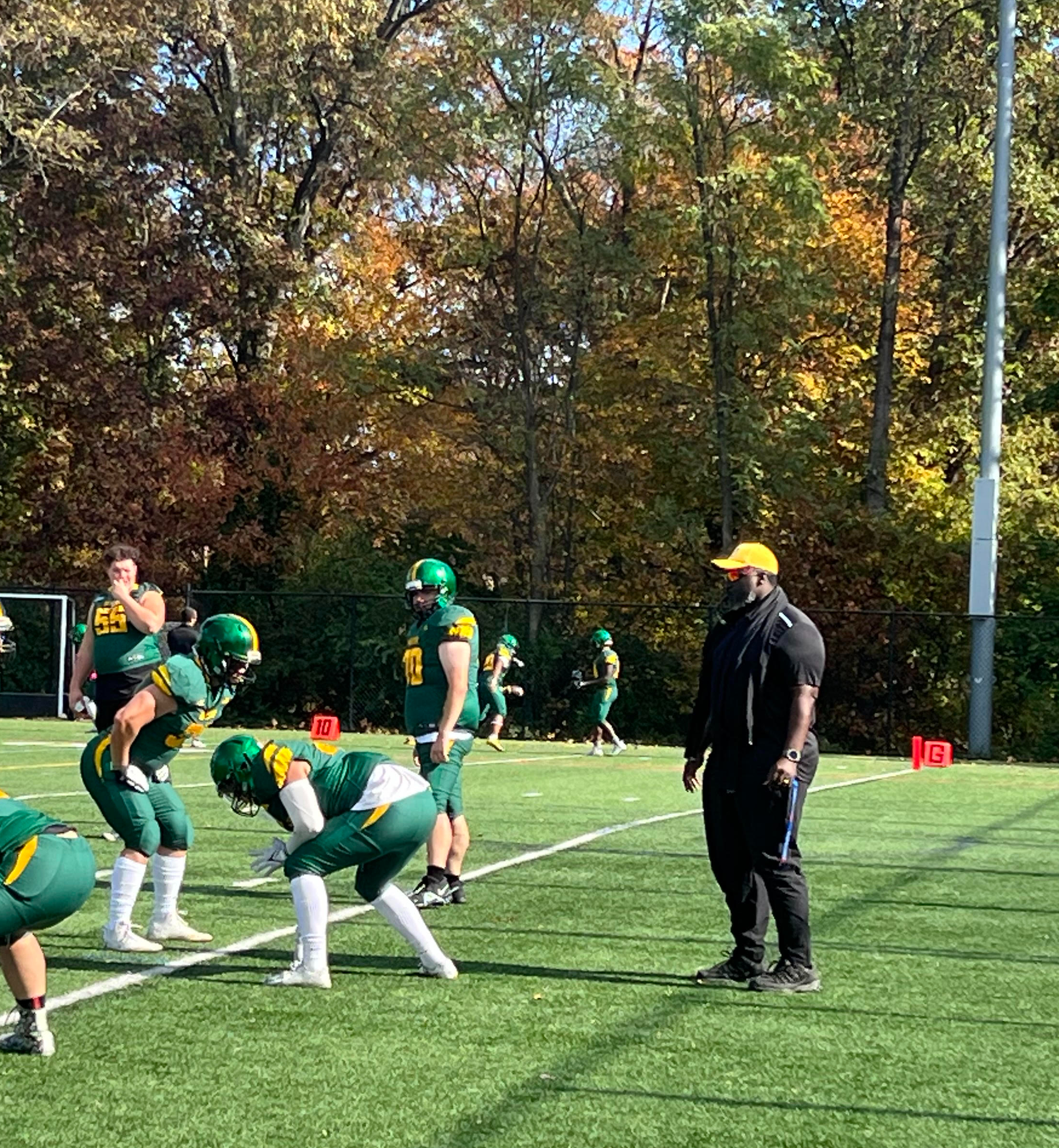
According to their website, The George Mason Club football team currently employs six assistant coaches, four of whom were on Raffles staff at TJ. For context, most club teams do not have that many coaches. “Not that the coaches they get are bad, it’s just that usually only have one or two [coaches] on the sideline, and that’s difficult. It’s hard to make that team successful that way.” Raffle explains. A large coaching staff and new uniforms aren’t the only thing that makes them stand out from the other teams they face. Their vision to turn George Mason’s club football team into a serious program will often catch the eye of opposing players. “We’ve had several players from opposing teams that have spoken with us after games, and are transferring in the spring.”
As the players continue to warm up, fans begin to trickle onto the bleachers by the handful. It is George Mason’s final home game of the season, and volunteers are taping up poster boards to celebrate the seniors in what will be their final game at George Mason. Club football is unique because a lot of control is in the hands of the players. They get experience in handling the administrative tasks that would normally be handled by the coaches or the universities. Because the players have so much control, it is important that the leadership shares the same values and goals as the coaching staff.
This particular group of players has seen a lot of success in their time playing football at George Mason. Last season they went all the way to the National Championship semi-final before they lost to Ohio State. This season they are 7-1 with their only loss coming to Sacred Heart University in Connecticut. This is a team full of players who receive none of the amenities that a varsity NCAA football team would get. They get no private dining room. No private weight room or clubhouse. They are forced to make football work around their class schedules instead of getting first dibs on class selection the way other athletes do. They work hard to ensure that they can be as present during the week as possible so that when it comes to game time on Saturday, they are prepared to dominate their opponent.
For many players, this is a second chance at having a college football career. For some, this was an opportunity that they didn’t even know existed. Team President Cole Jasmin was quite literally pulled off of the street because the team had a series need at quarterback. “I became friends with some of the guys on campus, and when they found out that I had experience as a quarterback they, asked me if I wanted to play,” said Cole, “I didn’t know they had a team or I probably would’ve been out here sooner.”
Seth Constable was recruited to play football at the Division I level before an injury ruined his opportunity. Now a grad student at George Mason, Constable has rediscovered his passion for playing and he has been doing everything he can to stay on the field, “I chose not to graduate last year and I signed up for one class this semester so I could play one more season, anything to play more ball.”
The coaches and players are seemingly all bought in on the goal to make George Mason’s club football team a legit college football program. The dedication and time commitment are there. They have specific routines and an identity that most major programs struggle to find. The only thing standing in their way of achieving greater things is that they are a club team—and the other club teams they play against do not always share the same passion.
“If the school said ‘we can only give you $100k’ we would be set. That would cover referee fees, travel, everything.”
1:30 PM. George Mason’s opponent finally arrives 30 minutes late. They only show up with eight players, however, with a promise that three more are on the way. Players on the Mason side are frustrated with the situation. They just want to play football, but it looks like the other team is going to have to forfeit. This would be the third time this has happened to them this season, and the Seniors will not get to play a final home game. Other club teams around the country are often not as reliable because they do not have the numbers that Mason does, nor do they share the same passion as the players on Mason’s sideline.
Being a club team limits the type of opponents George Mason can schedule. There are not many club football teams in the area, and they often have a tough time traveling to away games in numbers. If George Mason were an NCAA or NAIA affiliated team, they would be able to schedule reliable opponents from all over the area. It costs money to be in those leagues and the buy-in for the NCAA is very steep.
According to the NCAA guidelines, to be considered for a spot in college football’s highest division, the school must average 15,000 fans in attendance at least once every two seasons. George Mason’s current facilities do not accommodate that, so the current stadium will likely either need to be remodeled, or completely rebuilt. The cost for a 15,000-seat stadium would be estimated at around $450 million and it would likely take years to build. The time it would take to build the stadium would not be a big issue, because the University will also have to build extra facilities for a football team of up to 80 athletes.
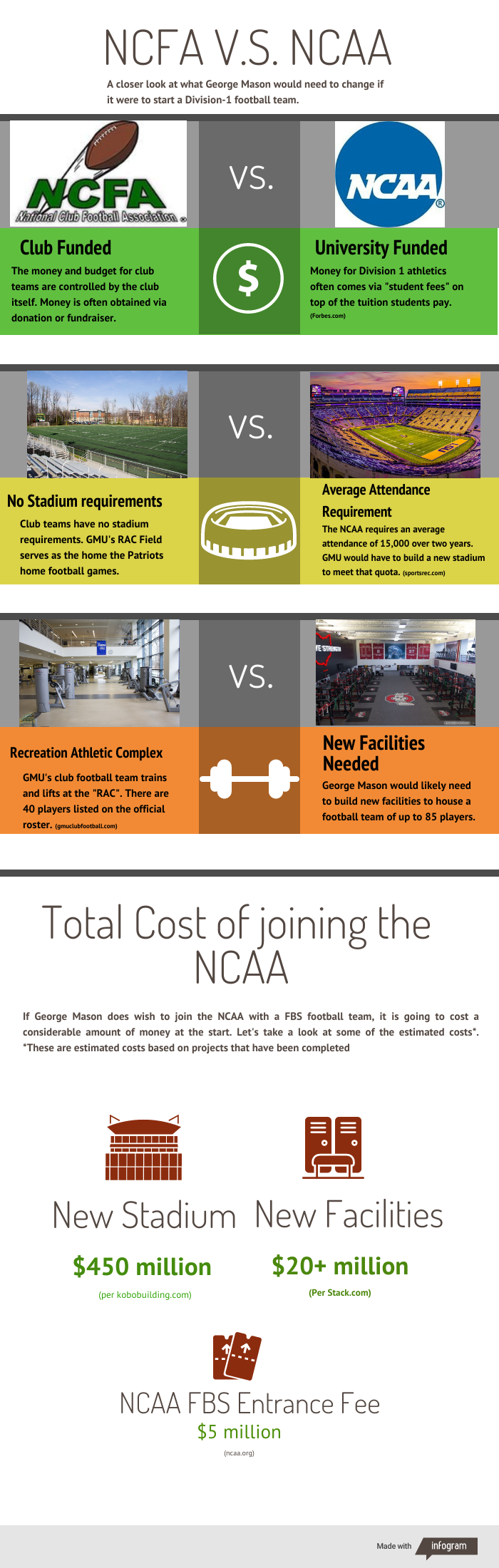
For a school that prides itself as a basketball school, the cost of that endeavor may be too much for George Mason. Becoming an NAIA team doesn’t come with much prestige, but it is considerably cheaper and team VP Basil Hasan believes George Mason has the infrastructure to compete right away. “Finding opponents is tough. If we were an NAIA school, we wouldn’t have to change our operation at all.” Hasan aspires to work in the front office for an NFL team one day. He says the experience he has gotten from running George Mason’s team has been invaluable. Being the VP of a college football team lets him get experience that most other students around the country would only dream of. Handling the financials and logistics for a team of over 40 players can be stressful, but Hasan thinks that if the school were to kick in a little bit of money, they could thrive as a varsity football program. “If the school said ‘we can only give you $100k’ we would be set. That would cover referee fees, travel, everything.”
It is clear that the coaches and players of George Mason’s club football team are hungry for more. They are passionate about football, and they wish to turn George Mason into a serious program. The only thing standing in their way is the University and their commitment to building a team. For coach Arron Raffle, he believes it is important to lay the foundation of a strong program now, so when the school does decide to give the green light, George Mason will already have an established tradition and culture. “There’s always a desire to try to turn that team into something more than just a club sport, you know. I mean, it’s fun the way it is. But you know we do want to be able to offer more. And there’s nothing like that in Northern Virginia. Right now, you have to go south. You gotta go to JMU, you gotta go to Charlottesville and Blacksburg, and you know, we want to be the next one.”
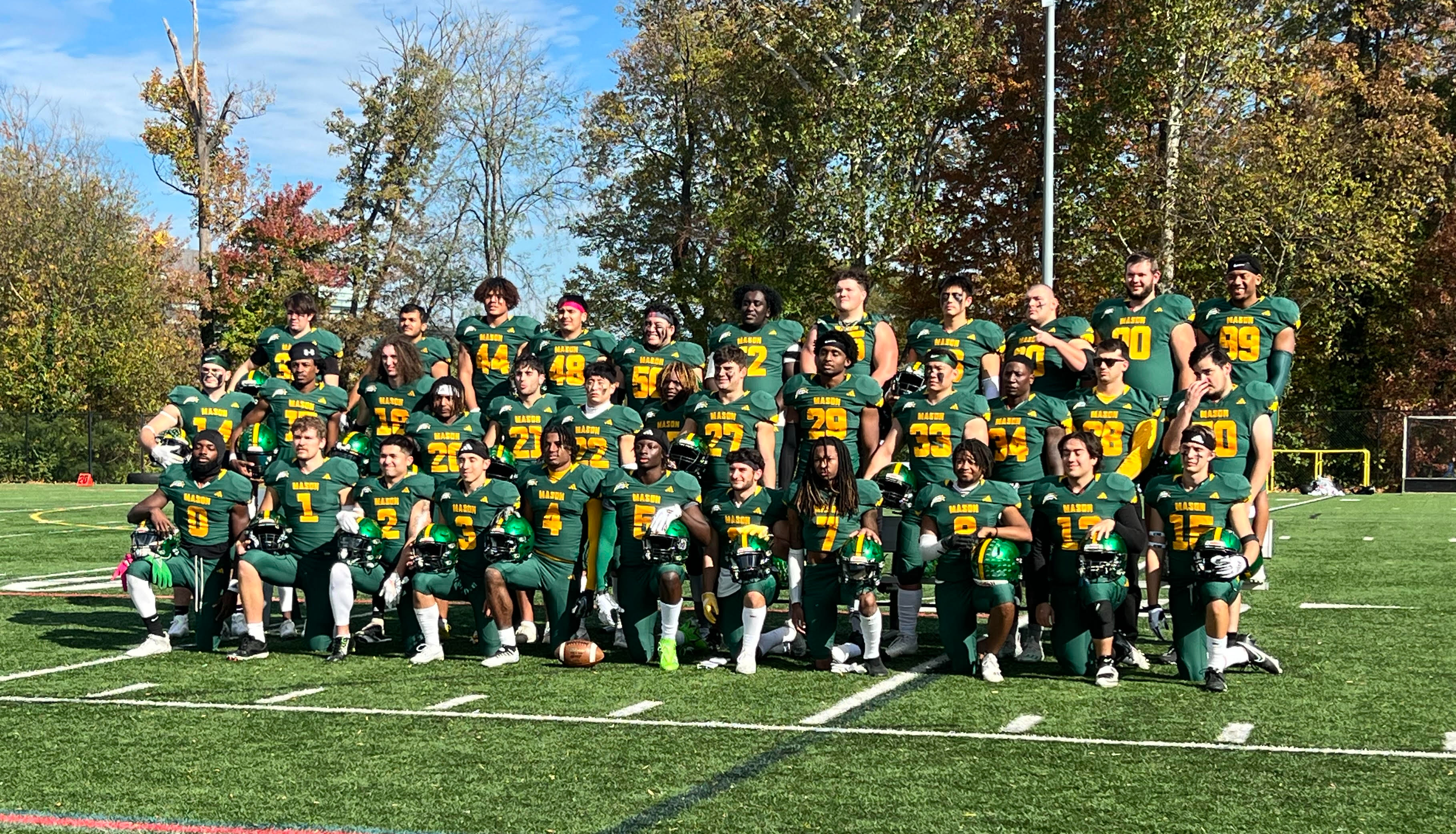
2 PM. The game has officially been canceled. The opposing team did not have enough players to field a team, and the players begin to break the news to their friends and family that traveled to the game. Although they are unable to play, it is important for the coaches and players to recognize the Seniors and give them their flowers. As the team lines up, Raffle travels up to his DJ booth in the bleachers and begins to introduce the Seniors one by one. They receive their mementos made by volunteers and the team gathers for a photo. Many of these players will not be here next season. This will be a new team with new faces. But, for Raffle and his staff, the work is just beginning.
 Brett Sprinkel - COMM 361
Leave a comment